
Oliver Wolfs
Ask a Commercial Director what Excel costs them, and they'll describe the hours. Monday morning, rebuilding the master sheet from a dozen email threads. The weekend before a board meeting, reconstructing the sponsorship summary from memory. The WhatsApp group that quietly became the official record of matchday seating. Those hours are real, and they add up.
The hours are easy to see. They show up in late nights, Sunday spreadsheets, and a pre-renewal panic that can take two weeks to work through. They feel like the cost, because they're the part of the problem you can actually feel.
But they're not the real cost. The real cost is the revenue clubs lose silently, without ever noticing it left. This article puts a number on that loss, and most clubs are surprised by how large it turns out to be.
Let's start with what you can see. A typical First Division club's commercial team spends roughly 1,000 hours per year on admin that could be automated. At an average commercial salary, that's around €20,000 in annual labour cost.
Those 1,000 hours break down across several categories. There's the recurring admin: contact updates, rights tracking, contract filing, and monthly report rebuilding. And there's the event-driven admin: matchday coordination, the pre-renewal scramble, the board meeting pack that takes a full weekend.
Both categories share the same characteristic. It's work the team already knows shouldn't be happening. Every Commercial Director has thought about it. Very few have actually sat down and calculated it.
When they do the math, the number is almost always higher than what they expected.
Add the disconnected tool stack on top. Most commercial teams run on four to six separate tools: Excel, Outlook, WhatsApp, a PDF folder, a shared Drive. Replacing that stack with one integrated platform saves roughly €15,000 per year.
Clubs are already paying that €15,000, just spread across subscriptions that don't talk to each other. Add it up and the visible cost lands around €35,000 per year in wasted labour and tool overlap. That's already more than most sponsorship management platforms cost annually. And that's just what you can see.
Here's the moment that costs the most money. It happens every year, at every club, and almost no one treats it as a systems failure.
A sponsor's contract comes up for renewal. The Commercial Director builds a report from whatever data exists: email trails, old presentations, season notes. It takes two full days to assemble, and it's still incomplete.
The sponsor renews at 15% below last year. Or they don't renew at all. Or they use the incomplete evidence to negotiate a discount, and the club accepts it because there's no proof to argue otherwise.
This is what Excel does at the most critical moment of the commercial calendar. It doesn't just waste time. It strips away negotiating leverage exactly when it matters most.
The math is hard to ignore. A 15% renewal discount across €500,000 is €75,000, every single year. Research by Bain & Company shows that 5% better retention can grow profits by 25 to 95%. The club with documented proof wins the conversation. The one with a PDF accepts whatever is offered.
And it compounds over time. One sponsor who downgrades in year two and doesn't return in year three is a €50,000+ loss across two cycles. The long-term value of a retained partner is always larger than the current year's contract value. The commercial team knows this intuitively. Excel just makes it structurally impossible to act on.

Nobody sets out to miss a deliverable. But with 30, 50, or 100+ contracted rights across a dozen partners, things fall through. A spreadsheet with no automated alerts doesn't catch them.
The banner wasn't up for the first home game. The social post went live with the wrong handle. The logo in the match programme was at the wrong tier.
Each of these looks small on its own. Across a full season and a full partner portfolio, they add up into a real delivery gap. The sponsor expected 100% delivery and received 85%, and nobody at the club realizes it until renewal.
The financial consequence stays invisible until it isn't. At renewal, the sponsor either caught the gaps and is unhappy, or didn't catch them but simply felt less value. Either way, the club walks into the negotiation weaker.
Global sponsorship research consistently shows that perceived value is the primary driver of renewal intent. When rights aren't tracked in real time, perceived value ends up lower than actual value. The club delivered more than the sponsor believes, and that gap costs money at the negotiating table.
The fix isn't about working harder. Clubs that track rights manually are already working hard. The issue is visibility, and a spreadsheet offers none to the people who need it most.
Here's a number most clubs never calculate: 30+ person-weeks per season on hospitality coordination alone.
At a typical First Division club, hospitality requires two people for nearly a full week before every home game. That covers guest lists, seat allocations, dietary requirements, invitations, confirmations, and last-minute changes.
Seventeen games times two people times one day each comes out to 34 person-days. At the loaded cost of a commercial coordinator, that exceeds €45,000 per year — all spent on logistics a proper system would handle automatically.
That's not a rough estimate. That's the actual cost of a WhatsApp group masquerading as a hospitality management system.
The pain extends beyond the headline number. Research on manual data entry puts the annual cost per employee at over $28,500. In commercial departments where matchday logistics dominate the calendar, that figure is directionally consistent with what clubs are actually spending.
The errors compound it further: the VIP without an invitation, the partner whose table was double-booked, the post-match delivery report that took three days instead of generating automatically.
And beyond the errors, there's the relationship opportunity cost. Every hour spent chasing confirmations is an hour not spent building the kind of experience that makes a sponsor want to upgrade.

This cost has no line item. It's the hardest to quantify, and probably the largest.
When a sponsor has no visibility into what they're receiving, they judge the relationship by experience alone. Did the hospitality feel well managed? Did anyone reach out mid-season, or only at renewal time?
Without a partner portal, sponsors go months without seeing their contracted rights or their delivery progress. They start to feel like an invoice number instead of a partner.
Sponsors who feel like invoice numbers start looking for exits. They rarely write formal complaints. They quietly reduce their commitment, decline to upgrade, or let a competitor's pitch land instead.
The Commercial Director gets a polite email back. Budget "reallocated." It was never really about the budget.
The global sports sponsorship market will exceed $70 billion in 2026. Clubs compete fiercely to win deals, then leave the back door wide open. Partners who feel invisible are easy to lose.
The club that gives sponsors a real-time portal changes this dynamic entirely. Sponsors who can see their rights, track delivery, and manage hospitality without an email exchange stop feeling like invoice numbers. They start acting like strategic partners, and strategic partners renew.
Beyond the slow daily cost, there's the acute failure. It happens to every team eventually.
Two people edit different versions of the master file in the same week. The versions diverge and nobody knows which one is correct. A night of reconciliation work begins.
Or the file corrupts the night before the board meeting. Or someone deletes the tab holding three years of contract history. Or the formula in column K has been wrong for four months and nobody noticed.
A 2024 study found that 94% of business spreadsheets contain critical errors: formula errors, transposed values, rows attributed to the wrong partner. Most stay invisible until something breaks.
The errors aren't always obvious. Formula errors tend to persist for months because nobody is actively looking for them. A field with the wrong formula doesn't raise an alert. It just produces a number that looks plausible.
For a club managing a €2 to €10M portfolio, errors carry real financial consequences: a contract value logged incorrectly, a renewal date off by a month, an expiry missed entirely. By the time anyone notices, the deal has already been signed on the wrong number.
The trust cost matters too. When the board asks for a commercial overview and the numbers don't match, team confidence takes a hit — not because the team is doing bad work, but because the tool they're using can't hold up at scale.
There's a dimension the numbers don't fully capture: opportunity cost.
Every hour spent in a spreadsheet is an hour not spent on prospecting, activation, or relationship building. Every matchweek the hospitality manager spends coordinating guest lists is a matchweek not spent deepening partner relationships.
Sponsorship is a relationship business. The clubs that retain and grow deals aren't necessarily the best negotiators. They're the ones with time to actually show up. Excel systematically eats that time.
The clubs that grow commercial revenue year on year don't usually have bigger teams. They have better systems. When the admin disappears, the team gets to spend its time on the work that actually moves the needle.
The €180,000+ annual cost of Excel isn't just what walks out the door. It's also the upsell that never happened, the upgrade that never started, the five-year anchor partner who left because the relationship started to feel transactional.
Every lost renewal, every rights gap, every invisible partner traces back to the same root cause. The club is running a multi-million euro commercial operation on tools that were never designed for it. That's not really a systems problem. It's a strategic one.
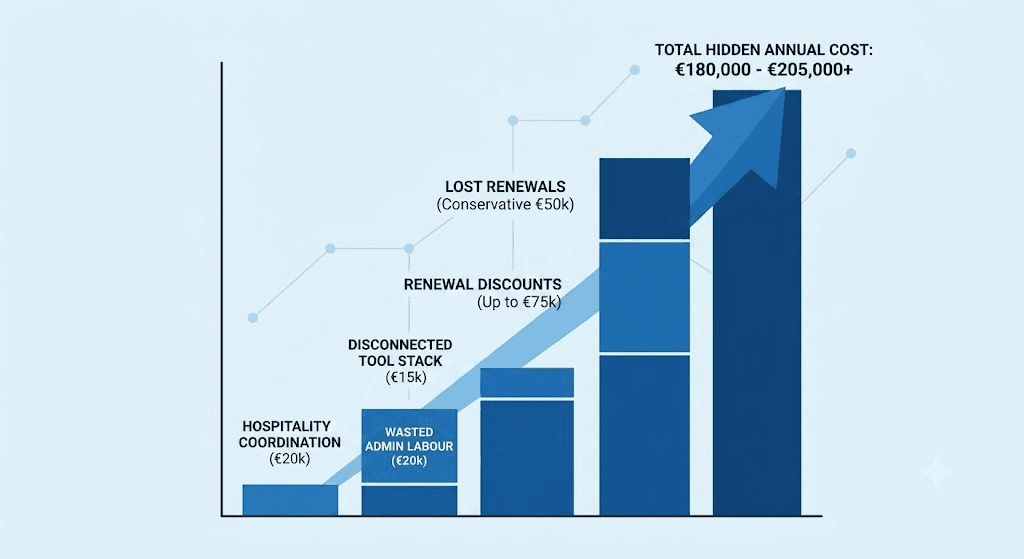
Let's add it up for a mid-size First Division club with a €500,000 annual portfolio, using conservative estimates throughout.
| Cost category | Annual impact |
|---|---|
| Wasted admin labour (~1,000 hrs) | ~€20,000 |
| Hospitality coordination (17-game season) | ~€45,000 |
| Disconnected tool stack | ~€15,000 |
| Renewal discounts from weak evidence (10–15%) | ~€50,000–€75,000 |
| One lost renewal per year (conservative) | ~€50,000 |
| Total | ~€180,000–€205,000 |
The sponsorship management platform that eliminates most of these costs starts free. The most common paid tier runs under €200 a month, roughly €2,400 a year. The ROI isn't complicated. Clubs have simply never added up the other side of the ledger.
Most clubs discover the comparison mid-calculation. They realize they've been spending €180,000+ on the problem and €0 on the solution. The math doesn't require a spreadsheet.
The good news is that every cost on this list is preventable.
Automated rights tracking means no delivery gaps go unnoticed. Partner portals mean sponsors see their value in real time instead of in a PDF nine months later. Automated hospitality management removes the matchweek coordination overhead entirely.
Renewal workflows with proof of delivery mean the renewal meeting starts from documented evidence. The Commercial Director walks in prepared. The sponsor who would have quietly downgraded renews at full value instead.
wehave replaces the spreadsheet stack at professional clubs: CRM, rights tracking, hospitality, portals, invoicing, and AI in one platform. It starts free, takes under an hour to set up, and requires no implementation project. The typical team of three or more gets 1,000 hours back per year and saves €15,000 in replaced tools. The company started with one observation: sports clubs were managing €10M+ portfolios on Excel.
Start free at wehave.io. Running before your next matchweek.
Start for free →Most commercial teams know Excel costs them something. They've felt the Monday admin, the pre-renewal panic, the matchday WhatsApp chain. They just haven't added it up.
€180,000 to €205,000 per year, at a mid-size First Division club, using conservative estimates. That number is sitting in spreadsheets across Europe right now.
It doesn't require a large club, an unusual portfolio, or exceptional mismanagement. It's the baseline cost of using the wrong tool for the job. Most clubs have been paying it for years without realizing it had a name.
The fix starts free. No sales call, no implementation project, no six-month rollout. Start at wehave.io and have it running before your next matchweek. Stop paying for a problem that was solved years ago.
Isn't Excel free? Doesn't that make it the cheapest option?
The licence cost is near zero. The operational cost is not. Admin hours, renewal discounts, lost partners, and hospitality overhead reach six figures a year at a mid-size club. The platform that replaces all of this starts free too. The real question isn't whether Excel is free — it's what Excel is actually costing you. Most commercial teams have never done that calculation.
How do I calculate the real cost for my club?
Start with three questions. How many hours a week does your team spend on admin a system should automate? What did hospitality coordination cost in staff time last season? And what renewal discounts did you accept in the past two years? Add those numbers together. Most clubs are surprised by the total. The hospitality figure alone tends to end the conversation.
Does sponsorship management software really make a difference at renewal?
Consistently, yes. Automated proof of delivery changes the negotiation: every right documented, every matchday recorded, every interaction logged. Partners who see their value through a live portal renew at higher rates and higher values. Clubs on Excel have no equivalent to offer. The renewal conversation starts with a PDF and ends with a discount. Clubs with a platform start with evidence and end with the full contract value.
At what point does Excel become a serious problem?
Earlier than most clubs expect. With just 10 active sponsors and one manager, admin time already exceeds the annual cost of most sponsorship tools. Every sponsor added widens the gap. The mistake is treating Excel as good enough for now — it has a real cost from day one. The other underappreciated threshold is team size: once two or more people are editing the same files, version control failures become inevitable.
What do sponsors actually want from the relationship?
Transparency and responsiveness. They want live visibility into what's been delivered, not a PDF at year-end. They want to manage their hospitality without waiting days for a reply. A club that provides this differentiates its partnership offer. That difference shows up at renewal, at upsell, and in the referrals sponsors make to other brands.
What if we can't get internal buy-in for new software?
Start with the numbers. The hospitality coordination cost alone — €45,000+ a year — is a compelling case at any commercial meeting. Most people in the room don't know that number yet. The argument isn't really about buying software. It's about stopping a €180,000-a-year loss. That reframe tends to change the conversation.
wehave gives commercial teams everything they need - CRM, live inventory, partner portals, hospitality, and AI - in one place.
Get wehave free →