
Oliver Wolfs
Most commercial teams at professional sports clubs send sponsors the same PowerPoint, rebuilt from scratch, every month. A different team member assembles it each time — same data, manually copied, same logo, repositioned. Two to four hours per report, per partner, per reporting period.
Multiply that across 30 sponsors and a 17-game season: hundreds of hours a year on work a system should do. None of it is strategic. It is formatting and copying.
This guide covers how to stop doing it that way. Below is a step-by-step approach: from auditing what you produce to giving partners real-time visibility into their rights and results. Each step builds on the one before it.
Sponsors judge your club's professionalism partly on the quality of your reporting. A partner who receives structured monthly evidence of delivered rights is a partner who renews. A partner who hears nothing until their contract expires is a partner whose renewal you will spend weeks chasing.
In practice, transparency at renewal time is one of the strongest predictors of partner retention. The audience size and media value matter less than whether the sponsor felt looked after. Reporting is how you demonstrate that.
Automated reporting is not a luxury for large clubs with analytics teams. It is a baseline expectation most professional clubs are still failing to meet. Falling short creates a commercial vulnerability at every renewal. Most clubs only realise it when they're already chasing.
Before automating anything, list every report you send to sponsors. Include the frequency — weekly, monthly, end-of-season — the delivery method, and how long each one takes to produce. Include informal updates too: the matchday WhatsApp, the post-event photo dump, the spreadsheet emailed before the renewal call.
Most clubs underestimate how much reporting they are already doing. They just do not realise it because none of it is systematised.
Most clubs find they produce three core report types:
Map each report type to the data it requires. Common data sources include matchday stats, social media reach, rights delivery logs, hospitality attendance records, and partner portal activity. Once you know what feeds what, you can build a system around it.
This audit also tells you where the biggest time waste is. The season summary takes longest for most clubs. It pulls data from multiple sources that were never designed to talk to each other.
Automated reporting cannot happen when your data lives in five different places. You need one source of truth. Every contracted right, every delivered asset, and every partner interaction must be logged in real time.
If you are currently managing sponsorships on a spreadsheet, this is the first thing to fix. There is no way to automate a report from a spreadsheet that different people update at different times. The source data is never clean or current enough.
The right infrastructure is a sponsorship management platform with native rights tracking. Every contracted right is logged in the system, every deliverable marked as delivered or outstanding, and every partner interaction timestamped. That is the raw material your reports pull from — and without it, everything downstream is still manual.
If your club runs hospitality across a home season, this step matters even more. Hospitality attendance, dietary requirements, check-in records, and post-match guest summaries all need to flow into the same platform. Otherwise, your match report is missing half its data at send time.
Social media reach, matchday attendance, and hospitality records are the three most commonly siloed data sources at professional clubs. Getting them into one platform before you automate is the difference between a complete report and one with obvious gaps. Start with whichever source currently takes the longest to pull manually — that is your first integration priority.
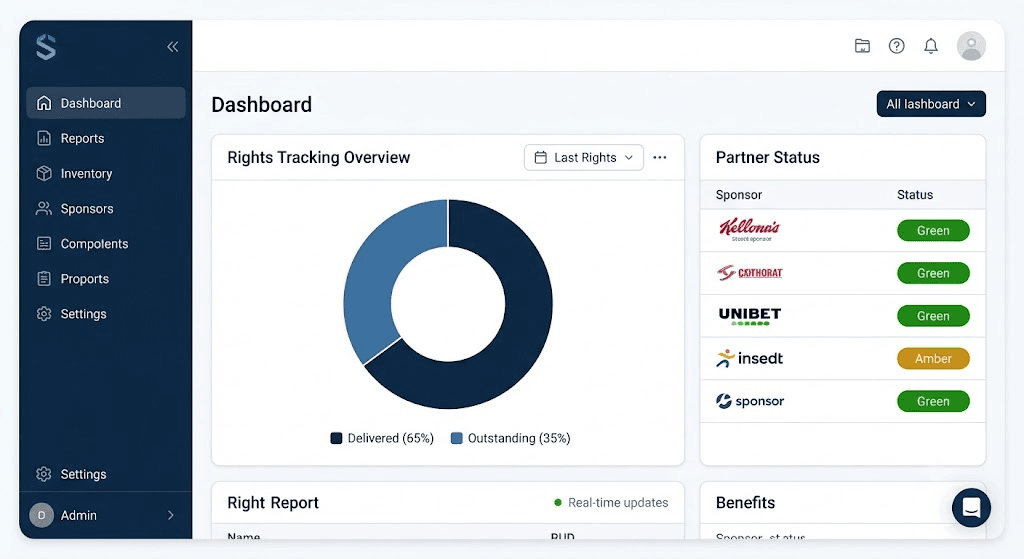
Once your data is centralised, decide what each report should contain. A match report and a season summary need different templates. Create a standard for each report type before you automate — otherwise you are automating inconsistency.
For most clubs, a good match report includes:
A season summary goes deeper: full rights delivery audit, year-over-year comparisons, ROI data where available, and a renewal case. Standardising templates is the step most clubs skip. Without a fixed template, every report is still a manual creative task — even if the underlying data is centralised.
The gap between a centralised platform and a truly automated report is the data connection. Reports need to pull live data — not require someone to export a CSV and paste it into a template.
The best sponsorship platforms handle this natively. When a right is marked as delivered in the system, it appears in the next report automatically. When hospitality attendance is logged on matchday, it flows into the partner's match recap without any manual step in between.
wehave's automated reporting does exactly this from the Growth plan onward. Reports are generated with synced data, branded for the club, with year-over-year comparisons — without anyone rebuilding a slide deck. The process that used to take two to four hours per partner now runs automatically.
The commercial time saving is real. wehave clients typically reclaim 1,000+ hours per year across a commercial team of three. Most of those hours were previously spent on reporting and coordination tasks.
The knock-on effect matters for sponsor relationships too. Because the underlying data is always current, whenever you do share a report — end of month, end of quarter, whatever cadence you've agreed with that partner — it reflects what actually happened, not a rushed reconstruction pieced together from memory and old spreadsheets.
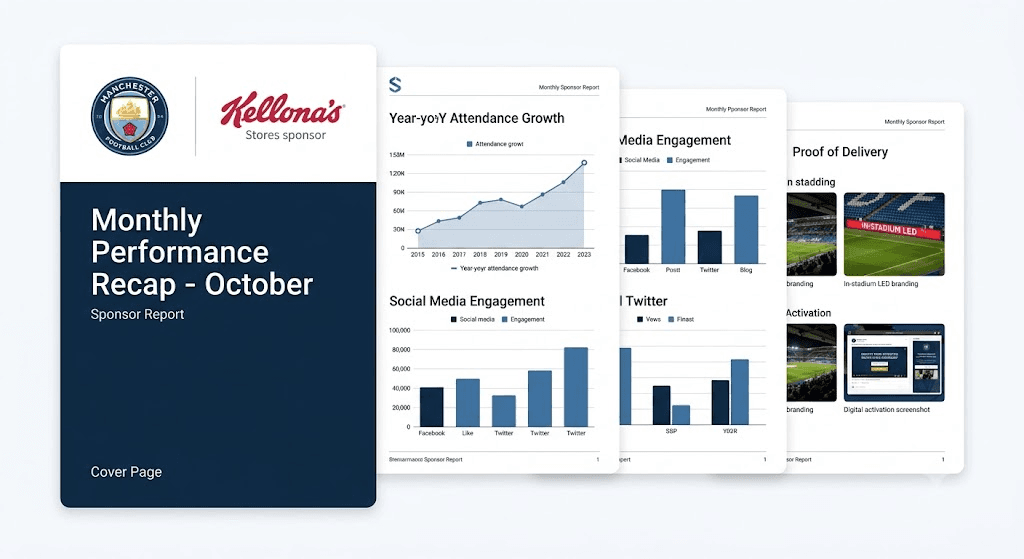
Automated reports are an improvement. But the best outcome is a sponsor who checks their status independently — not just when you send something.
Partner portals give sponsors a self-serve, branded space showing rights, bookings, and report data in real time. A sponsor can log in whenever it suits them — the morning of a hospitality event to see who's confirmed, mid-season to check their delivery score, or right before a quarterly review call — and the data is already current, without anyone on your team preparing anything specifically for that moment.
This changes the dynamic of the relationship. Instead of passively waiting for information, the partner is actively engaged with their investment. Sponsors who see their value in real time renew more — and ask fewer ad-hoc questions.
wehave's partner portals are available from the Starter plan. Free users get a wehave-branded portal; Starter and above get club branding. Pro and Enterprise plans get full white-label, with the portal appearing as a native extension of the club's digital environment.
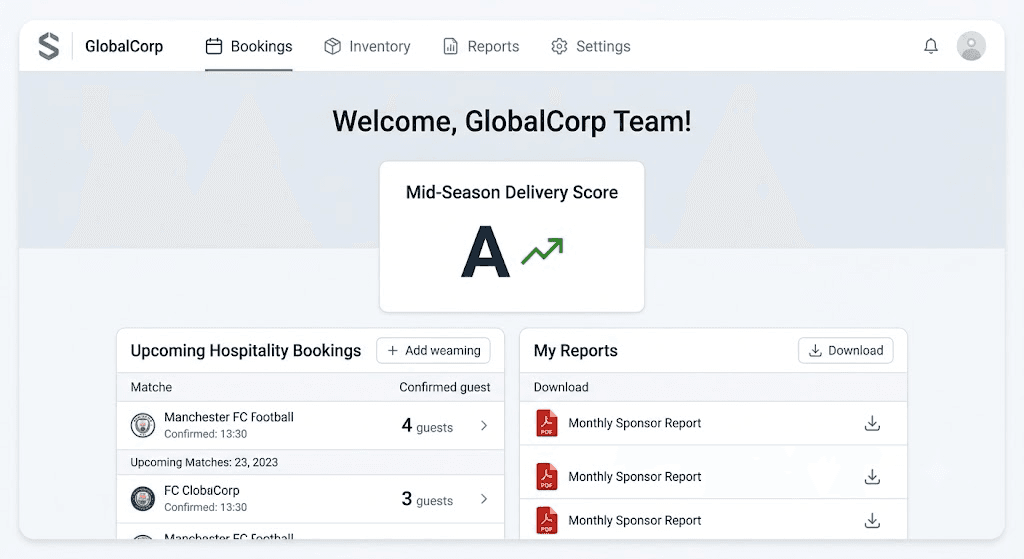
A report that is ready but unsent is still a manual task. The goal isn't to fire off a report after every single match — most sponsors don't want an inbox full of post-game PDFs, and most commercial teams don't want to manage that. The goal is that the report is always ready, so sending it is a non-event whenever the moment actually comes.
Agree a distribution cadence with each partner — monthly, quarterly, or whatever fits the size and expectations of that sponsorship — and automate the send at that interval. Because rights, attendance, and hospitality data are captured continuously in the background, the platform can pull everything that happened in the period into one structured report on demand, instead of someone reconstructing it after the fact. Season summaries follow the same logic on a longer cycle: set the date once, and it goes out automatically across the full sponsor base.
This removes the most painful coordination work from the commercial calendar — not because reports go out constantly, but because nobody has to remember to assemble one when the date rolls around. It is already done.
At a typical First Division club, hospitality coordination alone consumed two people for a full week before every home game. Across 17 games, that is more than 30 person-weeks — over €45,000 in coordination labour per season. Capturing hospitality data as it happens, rather than reconstructing it at reporting time, eliminates the majority of that burden — even when the report itself only goes out quarterly.

Here is where automated reporting becomes a commercial strategy — not just an admin fix. When every report is structured and tied to contracted rights, you have a renewal audit trail built across the season.
Walk into renewal with a report showing every right, every delivery status, year-over-year trends, and hospitality data. That is a different conversation than a PDF assembled the night before. The partner can see exactly what they received — and so can you.
Renewal reminders and workflows can also be automated. wehave's renewal workflows on the Growth plan trigger automatically at 90, 60, and 30 days before each contract end date. The commercial team stops chasing renewals at expiry and starts closing them with evidence already built.
The 90/60/30 approach works because it keeps renewal conversations on the club's timeline, not the sponsor's. By the time the contract ends, the conversation has been ongoing for three months. Partners who have been receiving structured reports are already informed. The renewal ask lands with context — not as a surprise.
Most clubs treat reporting and ROI measurement as separate workflows. Reporting is what you send during the season — attendance numbers, delivery status, match photos. ROI is what you scramble to assemble at renewal time.
The clubs using automated reporting have collapsed that distinction. Every report during the season simultaneously evidences delivery and builds the ROI case. By renewal time, the ROI report is not something you build — it is something you export.
When a right is marked as delivered, it is logged instantly. When hospitality attendance is recorded on matchday, it is timestamped. Both accumulate automatically — so the renewal audit trail is always current.
This matters most for sponsors who must internally justify the spend. A sponsor's finance director evaluates a document at budget time — not the match experience. Automated reporting ensures that document is always ready. It is a byproduct of how you run the relationship — not a separate exercise at season end.
wehave's Data Clean Room takes this further at the Enterprise level. Connect the club's fan data to the sponsor's customer data — with privacy intact — and the report goes from "here is what we delivered" to "here is how many fans became your customers." That is the report that makes renewal a formality rather than a negotiation.
Commercial teams at RSC Anderlecht, Feyenoord, and PSV now generate partner reports automatically. Real-time synced data, club-branded, no manual assembly.
The Sunweb x Anderlecht case shows what this looks like at the data layer. Sunweb's CRM and the Anderlecht fanbase were connected via wehave's Data Clean Room. A manual two-day analysis became continuous, automatic impact measurement. Sunweb could see which fans became paying customers, what they spent, and when revenue spiked around key campaign moments.
For the club's commercial team, the reporting burden — previously a manual exercise before every renewal — became automatic. The data was always current, always structured, always ready.
wehave — the only all-in-one platform built specifically for sports commercial teams. Automates rights tracking, match and season reporting, partner portals, hospitality coordination, invoicing, and renewal workflows. Free to start, no credit card required.
Shikenso — German AI-powered media analytics tool that tracks logo visibility in TV broadcasts, social media, and audio. Used by Royal Antwerp FC, Club Brugge, and KAA Gent. Shikenso measures brand exposure value and can complement a sponsorship management platform that handles the operational side. Both tools coexist well — clubs like Royal Antwerp FC use Shikenso for exposure measurement alongside wehave for operational management.
Google Looker Studio — free data visualisation tool for clubs that have centralised data but need a reporting front-end. Not sport-specific, but useful for creating dashboard-style reports when connected to a clean data source.
HubSpot — a credible first CRM step for clubs leaving Excel. HubSpot has strong pipeline management but no sports-specific features, no rights tracking, and no partner portals. It is a starting point, not a destination for a scaling commercial operation.
The clubs that have made this shift are not bigger or better-resourced than those still rebuilding PowerPoints. They made one decision: to treat reporting as commercial infrastructure, not admin. Setup time is under an hour — and time saved is measured in weeks per season.
You do not need to automate everything at once. Start with your most frequently produced report. Get the data into one platform, define the template, and connect the data source — then build from there.
The clubs winning commercially in 2026 are not spending more time on reporting. They are spending less. They are using that time for calls, renewals, and new partner conversations — the work that actually grows commercial revenue.
Free to start. No credit card, no demo, no implementation required.
Start for free →What is automated sponsor reporting?
It's when a sponsorship management platform generates partner reports directly from live, centralised data — rights delivery, attendance, hospitality records — instead of someone manually rebuilding a slide deck every month.
How much time can automation actually save a commercial team?
Clubs using automated reporting and rights tracking typically reclaim 1,000+ hours a year across a three-person commercial team, most of it previously spent on manual reporting and coordination.
What is a sponsor partner portal?
A branded, self-serve space where a sponsor logs in and sees their rights, bookings, and report data in real time — instead of waiting for the club to send an update.
Do we need to automate every report type at once?
No. Start with whichever report you produce most often, usually the match report. Get its data into one platform, standardise the template, then connect it to live data before moving to the next one.
wehave gives commercial teams everything they need - CRM, live inventory, partner portals, hospitality, and AI - in one place.
Get wehave free →